Our Directorates

Strategy & Transformation

Our Directorates

Strategy & Transformation

Help shape what comes next. Strategy and Transformation use insight and expertise to help turn our ambitions for babies, children and young people into meaningful, lasting change. 

Mike Woolf

Mike Woolf

Executive Director of Strategy and Transformation

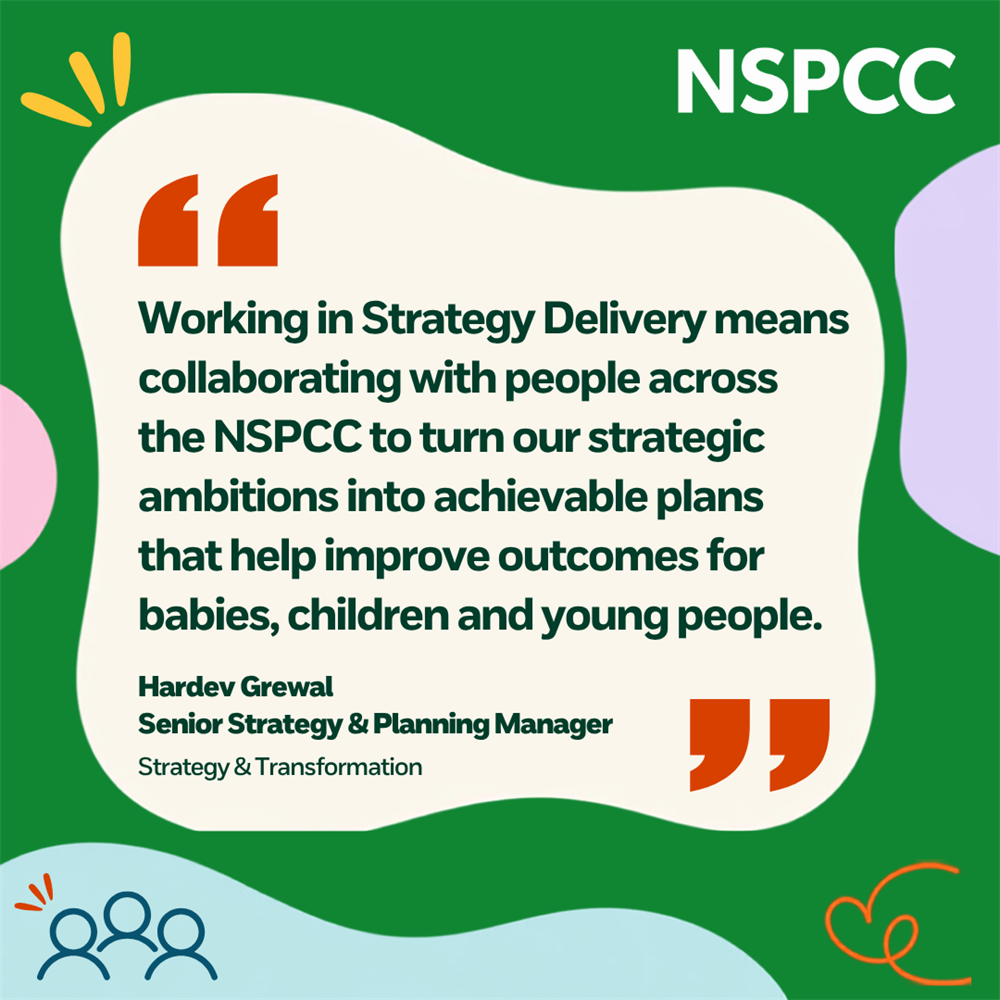
“Working at the NSPCC brings together the things I care about most – improving outcomes for children and young people – with the work I’ve spent my career doing: setting clear direction and leading the transformation that’s needed to be successful. What drew me to the NSPCC is the determination to do what’s right for children, even when that’s hard. Working in the Strategy and Transformation directorate allows us to continue to build on what’s already been achieved and help the NSPCC do even more for children.”
Why join us?

Why join Strategy & Transformation

Turning ambition into lasting change takes more than a good idea. It takes evidence, insight, careful planning and people who can bring different perspectives together to work out what needs to happen next.

In Strategy & Transformation, you could be helping shape our organisational direction, developing and testing services, understanding our performance and impact, or making trusted safeguarding knowledge accessible to the people who need it.

You’ll work across the NSPCC, connecting people, information and ideas to help turn strategic priorities into practical action.

It’s an opportunity to step back and see the bigger picture while still influencing what happens day to day, helping us understand what’s working, where we could do more and how we can continue to strengthen our impact for children.

About Strategy & Transformation

About Strategy & Transformation

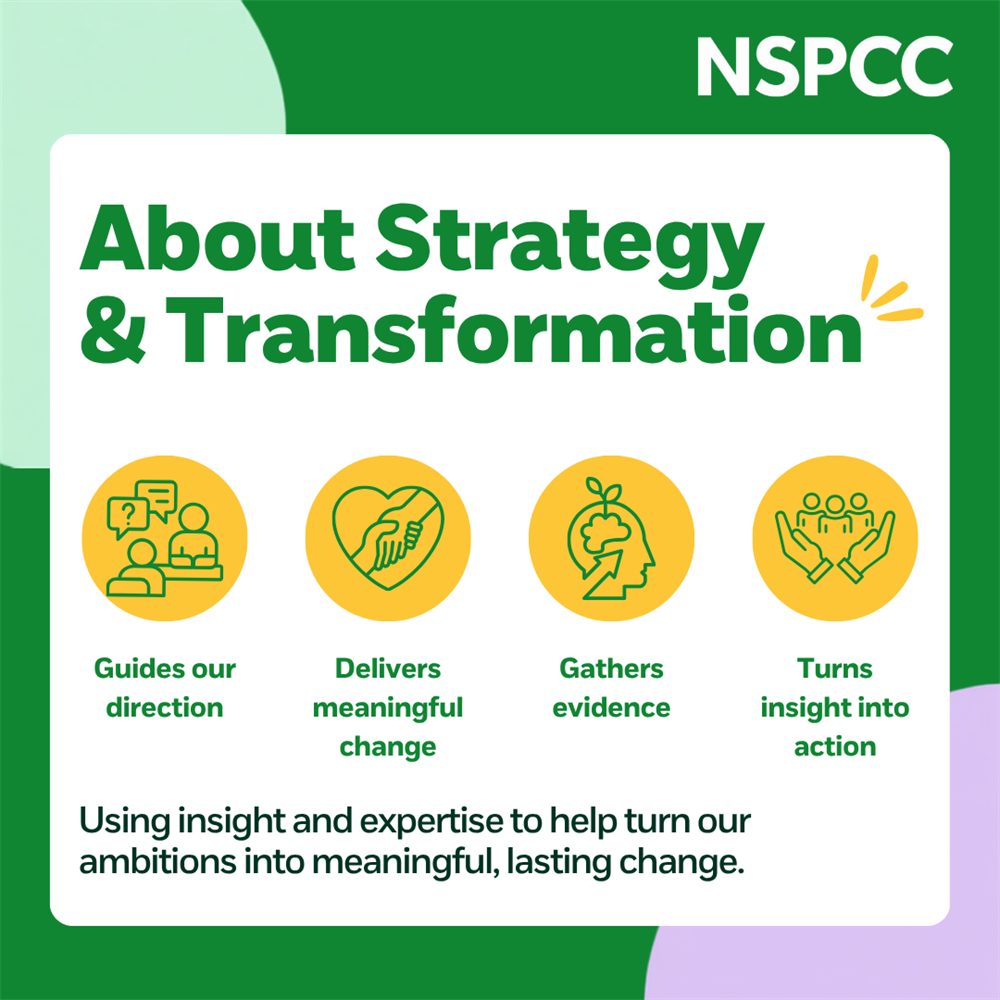
Our Strategy & Transformation directorate helps the NSPCC decide where we need to go next and how we get there.

We bring together expertise in strategy, performance, service development, implementation, knowledge and information to help the organisation make informed choices and deliver meaningful change. That means asking important questions.

What are we trying to achieve? What does the evidence tell us? How will we know whether something is working? What needs to change? And how do we turn an ambition into something that can make a genuine difference for children?

We work across the organisation to bring together different perspectives, translate insight into action and help make sure our priorities remain focused, achievable and grounded in what children and young people need.

Our teams

Our teams

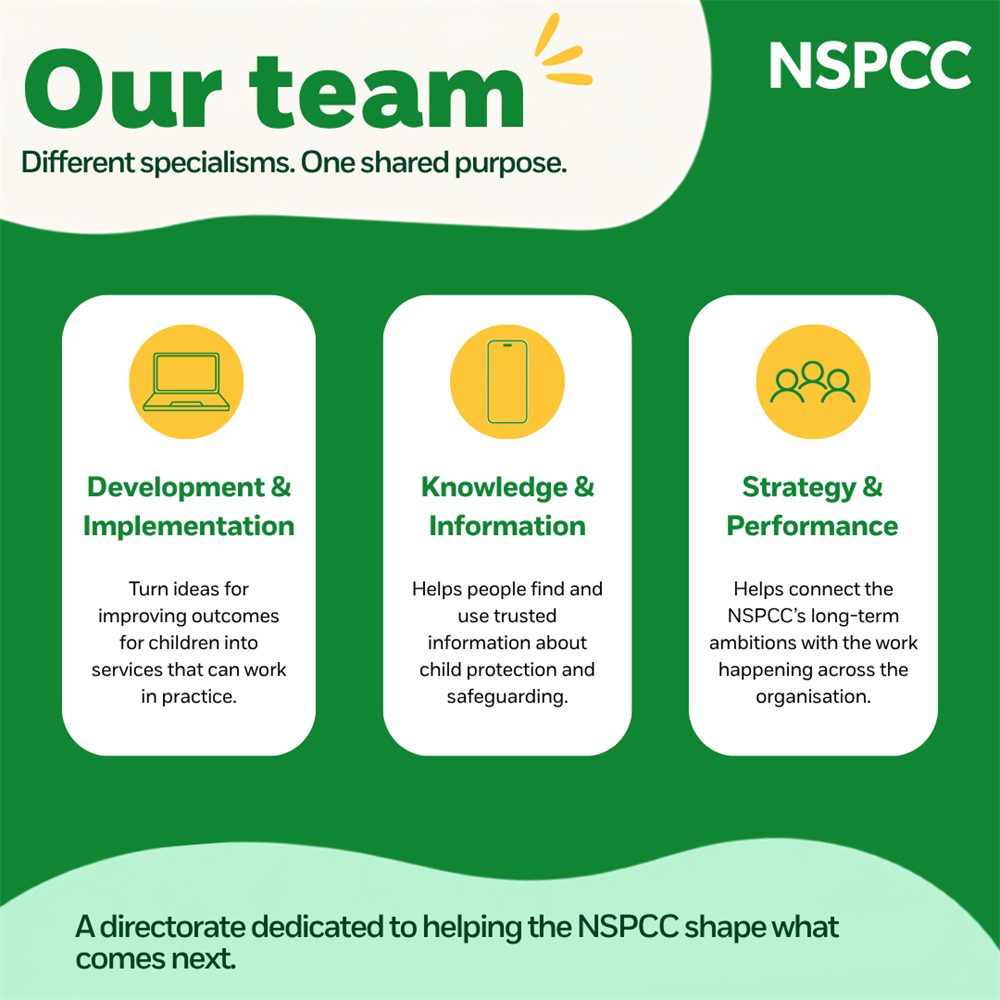
Our Strategy & Transformation teams work across three areas, bringing together strategic thinking, specialist knowledge and practical delivery to help the NSPCC turn its ambitions into action.

  • Our Development & Implementation team helps turn ideas for improving outcomes for children into services that can work in practice. They support the development, testing and implementation of NSPCC services, using evidence, insight and learning to understand what works and where approaches need to evolve. Working with colleagues across the organisation, they help take ideas from development through to delivery and consider how effective approaches can grow and reach more children and families. It’s about combining innovation with rigour, testing ideas carefully, learning as we go and making sure change is designed around genuine need.
  • Our Knowledge & Information team helps people find and use trusted information about child protection and safeguarding. They manage and develop specialist knowledge and information services, bringing together high-quality evidence and resources so professionals, researchers, colleagues and others can access the information they need. In an environment where the amount of available information continues to grow, their expertise helps people navigate it with confidence, making relevant, reliable knowledge easier to find, understand and use. Their work supports better-informed decisions, stronger practice and a deeper understanding of the issues affecting children.
  • Our Strategy & Performance team helps connect the NSPCC’s long-term ambitions with the work happening across the organisation. They lead and support strategic planning, bring together performance and impact information and work with colleagues to understand how well we’re progressing against our priorities. But performance is about more than reporting numbers. The team helps turn information into insight, asking what our results tell us, where we need to focus and what might need to change. By bringing together evidence, organisational knowledge and different perspectives, they help the NSPCC make informed choices about what comes next.

What we’re looking for

Seeing the bigger picture

Strategy means understanding how different pieces connect. You’ll look beyond an individual project or piece of information and consider how it fits with our wider ambitions, the environment around us and the needs of children. You’ll be comfortable making connections between ideas and thinking about both immediate priorities and longer-term impact.

Turning insight into action

Understanding something is valuable. Knowing what to do with that understanding is even more important. You’ll be able to take evidence, information and ideas and translate them into practical next steps. You’ll think about what is achievable, what will create value and what needs to happen to move an idea from discussion into delivery.

Constructive challenge

Good strategy depends on asking good questions. You’ll be willing to test assumptions, explore different perspectives and challenge established ways of thinking when there may be a better approach. You’ll do that thoughtfully and constructively, with a focus on improving the outcome rather than simply questioning for its own sake.

Collaboration and influence

Transformation rarely sits neatly within one team. You’ll build relationships across different professions and parts of the organisation, listen to different perspectives and help people work towards shared goals. You’ll be able to communicate ideas clearly and bring others with you, even when the way forward involves change.

Curiosity and learning

We won’t always know the answer at the beginning. You’ll be interested in what evidence, experience and feedback can teach us. You’ll ask questions, test ideas and be comfortable learning as work develops – recognising that sometimes the best outcome comes from adapting the original plan.

Focus on impact

Activity and impact aren’t the same thing. You’ll be interested in what our work is actually achieving and how we know. Whether you’re developing a service, shaping strategy or reviewing performance, you’ll keep bringing the conversation back to the difference we’re trying to make for children and young people.

View open roles

The application process

What to expect when you apply for a role with the NSPCC

 
Tell us if you have the
right to work in UK
 
arrow left
uk map
arrow right
 
Create an online account
Find the role you’re interested in and click ‘apply now’ on the job description page
question mark
person
 
Did you know?
Once you have created an account, you can dip in and out of this process and come back to it
 
Find the role you’re interested in and click ‘apply now’ on the job description page
down-arrow
Tell us if you have the
right to work in UK
down-arrow
Create an online account
down-arrow
Did you know?
Once you have created an account, you can dip in and out of this process and come back to it

 
Make sure you fill in all of the mandatory sections in full
 
arrow left
tick
arrow right
Log in to your
online account
 
exclamation mark
laptop
question mark
Please spend some time on the ‘Supporting Information’ section. Provide examples to evidence how your skills and experience meet our person specification, as we use ONLY this information to shortlist applicants for interviews.
 
Did you know?
If you meet our person specification and declare a disability, you’ll automatically be shortlisted for interview
 
Log in to your online account
down-arrow
Make sure you fill in all of the mandatory sections in full
down-arrow
Please spend some time on the ‘Supporting Information’ section. Provide examples to evidence how your skills and experience meet our person specification, as we use ONLY this information to shortlist applicants for interviews.
down-arrow
Did you know?
If you meet our person specification and declare a disability, you’ll automatically be shortlisted for interview

 
If not, you will
be invited to share your experience.
 
arrow left
thumb up
arrow right
conversation
 
folder
We’ll contact you either way to let you know if your application has been successful. If so, we’ll invite you to a panel interview.
question mark
If you’re through to interview, you should start gathering information you’ll need for the next stage of the process, like employment references and address history for the last five years
 
Did you know?
You can contact our People team on 0113 887 1122 if you have any questions about the process at this stage
 
We’ll contact you either way to let you know if your application has been successful. If so, we’ll invite you to a panel interview.
down-arrow
If not, you will be invited to share your experience
down-arrow
If you’re through to interview, you should start gathering information you’ll need for the next stage of the process, like employment references and address history for the last five years
down-arrow
Did you know?
You can contact our People team on 0113 887 1122 if you have any questions about the process at this stage

 
The interviews might be face-to-face or online, depending on the role
 
arrow left
person with laptop
arrow right
people
 
speach bubble thumbs up
Our interview processes will explore your skills, knowledge and values – and this can be done over more than one stage.
question mark
We’ll always provide feedback to all applicants following their interview, whether successful or not
 
Did you know?
Our interview panels are made up of the hiring manager for the role and a range of other relevant professionals selected from across our organisation
 
Our interview processes will explore your skills, knowledge and values – and this can be done over more than one stage.
down-arrow
The interviews might be face-to-face or online, depending on the role
down-arrow
We’ll always provide feedback to all applicants following their interview, whether successful or not
down-arrow
Did you know?
Our interview panels are made up of the hiring manager for the role and a range of other relevant professionals selected from across our organisation

 
If you’re successful, we’ll give you a conditional offer, and ask for more info so we can complete our safeguarding checks and referencing procedures
 
arrow left
hand shake
arrow right
speech bubbles
 
loud hailer
You’ll hear directly from the hiring manager after your interview, with feedback if unsuccessful
question mark
You can contact your hiring manager directly at any point during this stage.
 
Did you know?
We do this for all roles – some are more in-depth than others – and we can’t make any final offers until these are completed
 
You’ll hear directly from the hiring manager after your interview, with feedback if unsuccessful
down-arrow
If you’re successful, we’ll give you a conditional offer, and ask for more info so we can complete our safeguarding checks and referencing procedures
down-arrow
You can contact your hiring manager directly at any point during this stage.
down-arrow
Did you know?
We do this for all roles – some are more in-depth than others – and we can’t make any final offers until these are completed

 
Due to the nature of our work, it is important we complete a variety of checks and vetting procedures, which will vary with each type of role.
 
arrow left
clipboard
arrow right
refresh
 
reading
While the referencing process is taking place, we’ll regularly update you on its status
question mark
We’ll also share a welcome pack, so you can start getting a feel for the role and our organisation before you start
 
Did you know?
We need to rely on third parties to complete criminal records checks, and this can cause delays outside of our control (sometimes around 6-8 weeks).
 
While the referencing process is taking place, we’ll regularly update you on its status
down-arrow
Due to the nature of our work, it is important we complete a variety of checks and vetting procedures, which will vary with each type of role.
down-arrow
We’ll also share a welcome pack, so you can start getting a feel for the role and our organisation before you start
down-arrow
Did you know?
We need to rely on third parties to complete criminal records checks, and this can cause delays outside of our control (sometimes around 6-8 weeks).

 
They’ll email you with all the details you need before you start, including your contract of employment and your start date
 
arrow left
calendar
arrow right
speaking
 
laptop
Your hiring manager will get back to you directly to confirm your final offer
question mark
You’ll receive an induction email – with a welcome message from our CEO, information on what to expect, your team, available training and groups you can join
 
Did you know?
Once you start, we’ll email you with a link to the ‘New starters’ page on our intranet, the Green.
 
Your hiring manager will get back to you directly to confirm your final offer
down-arrow
They’ll email you with all the details you need before you start, including your contract of employment and your start date
down-arrow
You’ll receive an induction email – with a welcome message from our CEO, information on what to expect, your team, available training and groups you can join
down-arrow
Did you know?
Once you start, we’ll email you with a link to the ‘New starters’ page on our intranet, the Green.

final step
Find roles near you

Find roles near you

Have a look at our open roles near where you live:

1 miles

Prefer to work from home?

Talent Pools

We usually have a wide range of opportunities and we’re always on the lookout for great talent! Please join our talent pool so we can keep you updated on what is happening at NSPCC and let you know about any future roles that come up.

Welcome, I'm the NSPCC Bot and I'm here to help